The Engaged Scholar Fall 2025
Community Engaged Learning: High-Impact Learning for Cougs
During the fall semester, the CCE partnered with 85 faculty, graduate students, and staff to offer 138 service-learning classes with an enrollment of more than 4,300 students. WSU Pullman, Vancouver, and Global students in service-learning courses contributed over 10,000 hours of service locally, across the state, and around the globe. This semester, 61% of students in service-learning courses are first-generation students, and almost 2000 students are first-year students. Student community engagement not only makes a significant positive impact in the community, but for the students themselves. Service-learning (and community engagement more broadly) is a high-impact practice, which means that students who participate get higher grades, return to school year after year, and graduate at higher rates. Student success is a priority at WSU, and according to the National Survey of Student Engagement (NSSE), 64% of first year students report participate in a course that includes a service component.
WSU students volunteered in a multitude of ways including supporting underserved populations on the 9/11 Day of Service, raking leaves for the Pullman College Hill Neighborhood on Rake-a-Difference Day, CCE-Led (transportation provided) projects, and through a variety of course projects and individual volunteer activities. Of course, none of this would be possible without collaborative work with our community partners. We were honored to bring community, faculty, and staff together at our annual Campus Community Forum in October to continue to cultivate these important partnerships and sincerely appreciate all our partners' time and energy!
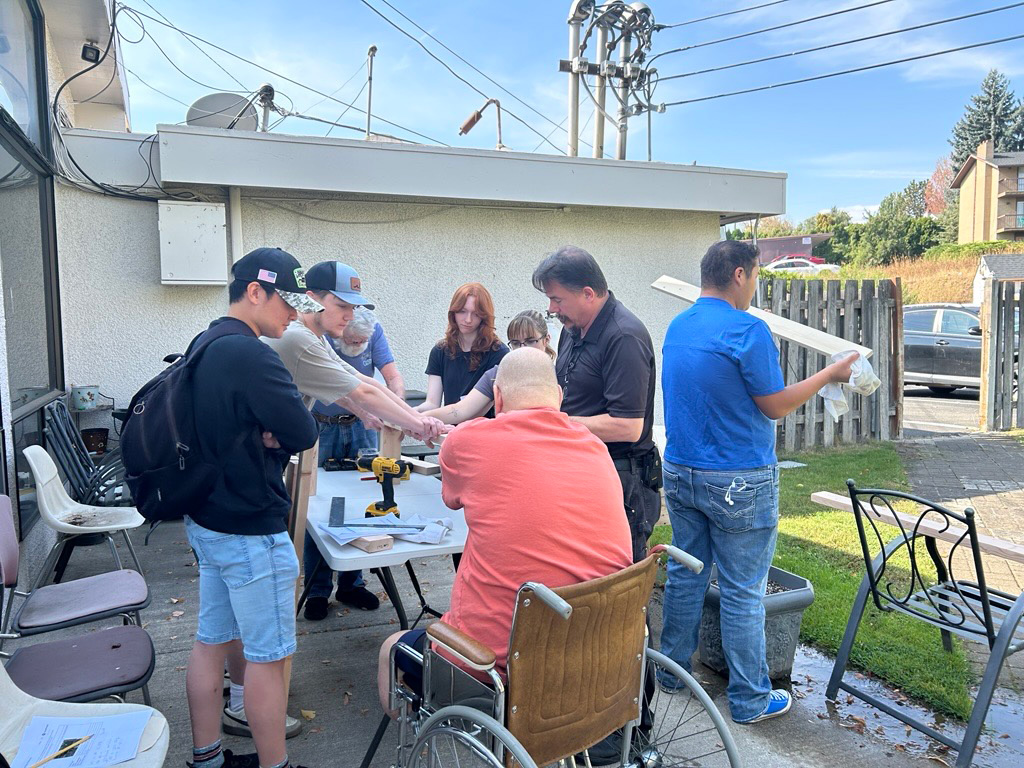
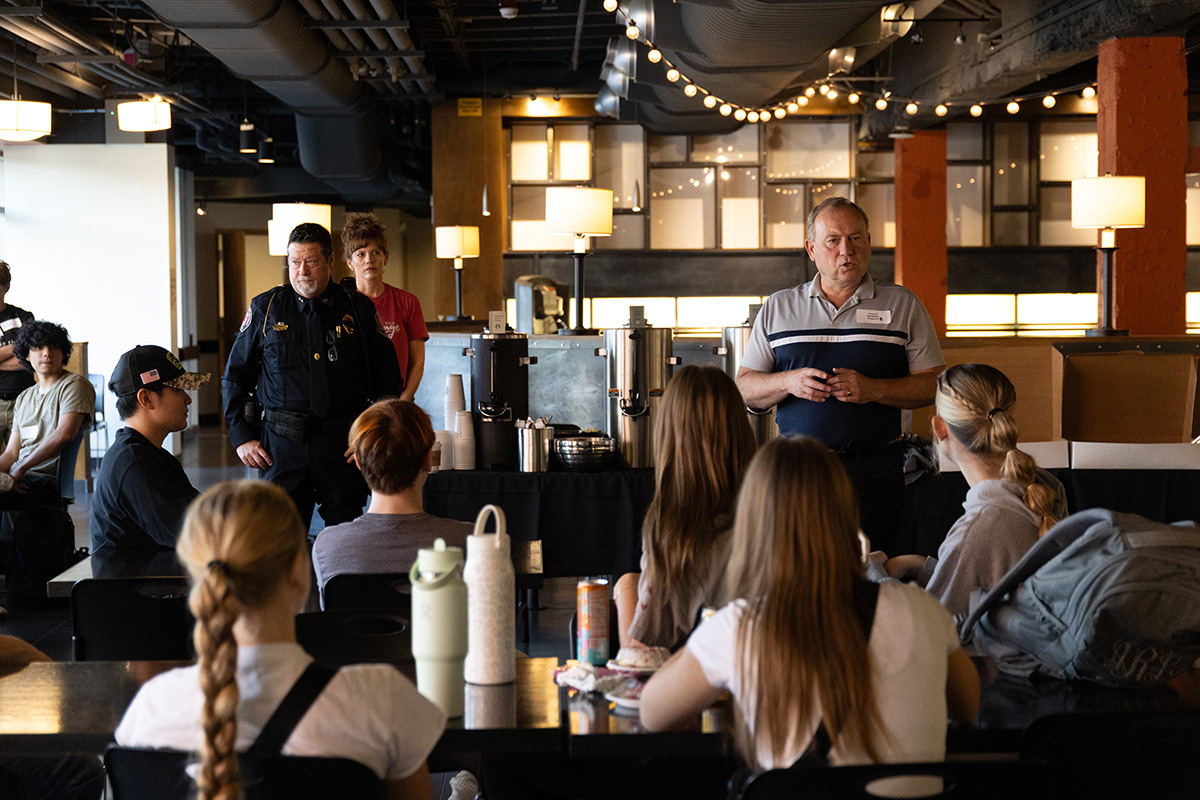
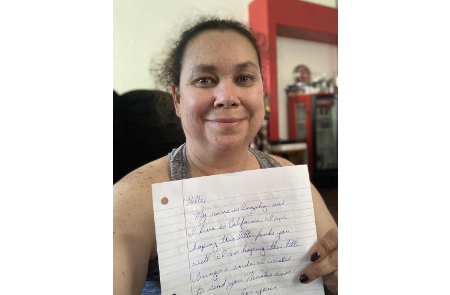
This fall, the CCE, with grant funding from the Washington Campus Coalition for the Public Good, held the inaugural WSU 9/11 Day of Service. Mayor Francis Benjamin and WSU Deputy Police Chief Harry Smith spoke to the volunteers before the morning and afternoon shifts to kick off the event, after which volunteers headed out to projects. Ultimately, 180 volunteers and WSU staff completed 33 service projects supporting nonprofit organizations in Colfax, Pullman, and Moscow. In addition, ten WSU Global students and staff participated in the 9/11 National Day of Service by completing remote community service projects, including writing letters to active-duty military members and their families, writing encouraging notes to children in foster care, and decorating brown bags for a local community pantry program.
Enriching Student Learning Through Engagement
Students in Rebecca Cooney’s COMSTRAT 383: Media Strategies and Techniques for Public Relations classes collaborated with the Pullman Regional Hospital Foundation to build awareness and support for their Regional High School Athletic Training Program. The Regional High School Athletic Training Program provides rural student-athletes in Colton, Garfield-Palouse, Pullman, and Potlatch with licensed athletic trainers. COMSTRAT 383 students focused on tailoring media content to highlight how the program helps student-athletes by using digital and traditional media tactics to show how important its mission is to under-served, rural student-athletes. This project gave students real-world, hands-on experience in creating consistent branding across multiple media platforms, developing a large-scale marketing campaign, creating digital and print content, and coordinating and managing deliverables.

PRH Director of Development, Annual Giving, & Auxiliary Liaison Stephanie Pierce met with COMSTRAT 383 students to provide context for the project and emphasized the impact of this work. This project allowed students to gain mastery of their course objectives while also learning how a marketing campaign can directly connect to a student-athlete's health and well-being.
Building Capacity Through Community Partnerships
As we entered the Fall season, our Community Partners team collaborated with local organizations in innovative ways by introducing new ‘walkable projects”. These projects support community organizations that are within walking distance to the WSU Pullman Campus. Walkable projects are facilitated by a member of the CCE Community Partnerships team. This model encourages students to step beyond campus and engage with the local community through hands-on collaboration with nearby partners. They were also created to promote environmentally sustainable community engagement practices. Together we walk, roll, and stroll to our destination, resulting in zero-emissions.
We had the privilege of planning walkable projects with Koppel Farms, Family Promise of the Palouse, and the College Hill Association. Most recently, the CCE community partnerships team led Rake-A-Difference Day in collaboration with the College Hill Association, where students helped rake leaves in the College Hill neighborhood and assisted residents with yard maintenance.
Students also participate in an ongoing walkable project with Family Promise of the Palouse, now located on Greek Row, contributing through a variety of supportive tasks. Overall, walkable projects have created more accessible and meaningful opportunities for students to collaborate with the local community and see the impact of collective community engagement.


WSU Global: Student Leadership & Engagement
WSU Global: Fall 2025 Cougar Leadership Program
The Fall 2025 cohort of the Global Cougar Leadership Program brought together twenty Global Campus students committed to developing their leadership skills and engaging in meaningful service, which is a significant expansion from the eight participants in Spring 2025. This reflects growing interest in leadership and civic engagement opportunities by the Global Campus students. Throughout the semester, participants engaged in a series of leadership development workshops, three of which were facilitated by CCE Graduate Assistant Oluyemisi Oloniyo: Empowering Others through Servant Leadership (October 1), a Mid-Program Check-In (November 5), and Leadership in Action & Reflection (November 19). These sessions emphasized leading with empathy, community-building, and reflective leadership practices.
A notable strength of this cohort was their high level of interaction and engagement. Students actively applied their leadership learning through hands-on community projects such as Send a Letter: A Million Thanks, White Spring Ranch Museum/Archive Library, Kids’ Food Basket, and other remote service projects.
Participants shared meaningful reflections on how these activities challenged their perspectives and shaped their leadership journeys. One student described the emotional impact of writing letters to military members:
“This project made me pause and reflect on how much our military, both active duty and veterans, have sacrificed. It gave me a chance to give thanks and express appreciation, especially knowing there were times in history when they were not appreciated and treated poorly. Thank you for your service!”
WSU Health Sciences Mentorship Program
From classrooms to clinics, WSU’s health science graduate and professional programs in Spokane aim to cultivate healthcare professionals from rural and underserved communities, who are most likely to return and serve their regions. To achieve this, WSU employs a two-pronged approach: an outreach and mentorship program beginning in 7th grade-11th grade that provides academic exposure, college preparation, and mental wellness education, and a peer-to-peer mentorship initiative that trains older students to guide younger peers, fostering interpersonal skills, emotional intelligence, and resilience. This fall, 65 WSU students participated in over 750 hours of community service with over 950 7th-11th graders in this program. These efforts, complemented by a suicide prevention program for rural areas, build well-rounded, capable students prepared for rigorous health science careers and long-term well-being. Designed and delivered by WSU health science faculty, staff, and students, the program can be adopted by other institutions and scaled statewide through WSU Extension sites, leveraging community connections to expand access and improve health outcomes in underserved regions. For further information, contact Jessica Gerdes, jessica.l.gerdes@wsu.edu.
Research & Innovative Activities Spotlight
During Fall 2024, a multidisciplinary team of WSU Vancouver faculty conducted assessment with over 70 undergraduate students enrolled in community-designated STEM courses. Their findings were recently published in the proceedings for the 43rd Annual SIGDOC conference. Most students reported that community engagement helped them develop project management and communication skills and apply textbook learning in real-world contexts. Nearly nine out of ten agreed that WSU has a responsibility to address community needs through community-engaged courses. More details can be found in the full publication and in the October 2025 issue of the WSU Vancouver’s Curiosity Chronicals
Engagement News & Awards
The WSU Center for Civic Engagement and Office of the Provost recognized faculty and staff for their innovative community engaged learning practices that create transformative and high-impact opportunities for students and communities. Community and student engagement are strategic priorities of Student Affairs and Academic Affairs at Washington State University. 2025 Partner in Innovation Award recipients:
-
Annie Wilhelm
Student Reflection Quotes
This experience was really an amazing time to foster community building but also help others and the environment by planting the trees. I learned new things about trees I never thought of and met great leaders who were very patient and very helpful.
I think that participating in a community service event on 9/11 was a powerful reminder of how service can turn a day of tragedy into a day of unity. I think that we should take the time to remember the strength and courage that emerged in the face of devastation.
My service-learning experience connects to my long-term goals because the communication skills I am developing will assist me in my future career in vet med. I will need to be able to effectively communicate with my coworkers, clients, and possibly zoo/sanctuary guests. Through my community service, I am learning how to talk to a wide variety of people of all ages and backgrounds, from memory care patients to little kids.
The most valuable service the Humane Society has offered me is the opportunity to learn from real experiences and connect with people whose lives and perspectives are different from mine. I am able to see the impact of community work, help me develop practical skills, and allow me to understand how even small actions can make a meaningful difference.
I had a great time being a volunteer for 9/11 National Day of Service. I definitely want to do this every year. Not only was I able to meet more students in WSU that are committed to service, I got to learn about people outside of WSU that are committed to service and where I can go if I need help.
It was emotional to try and explain to my kids why something like this would happen, why or how there could be so much anger or hatred toward other people. Hearing them talk about how everyone just needs to slow down and love each other gives me hope.